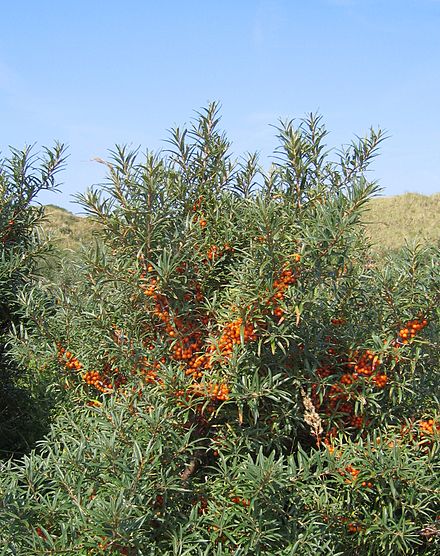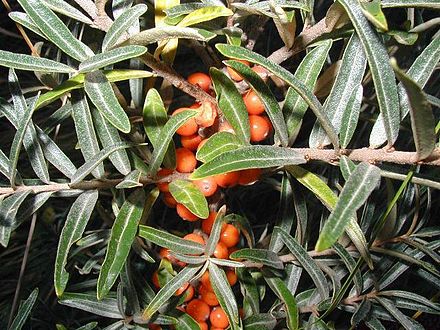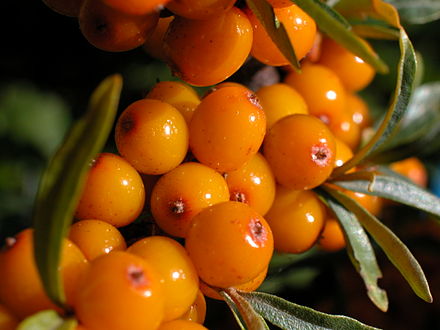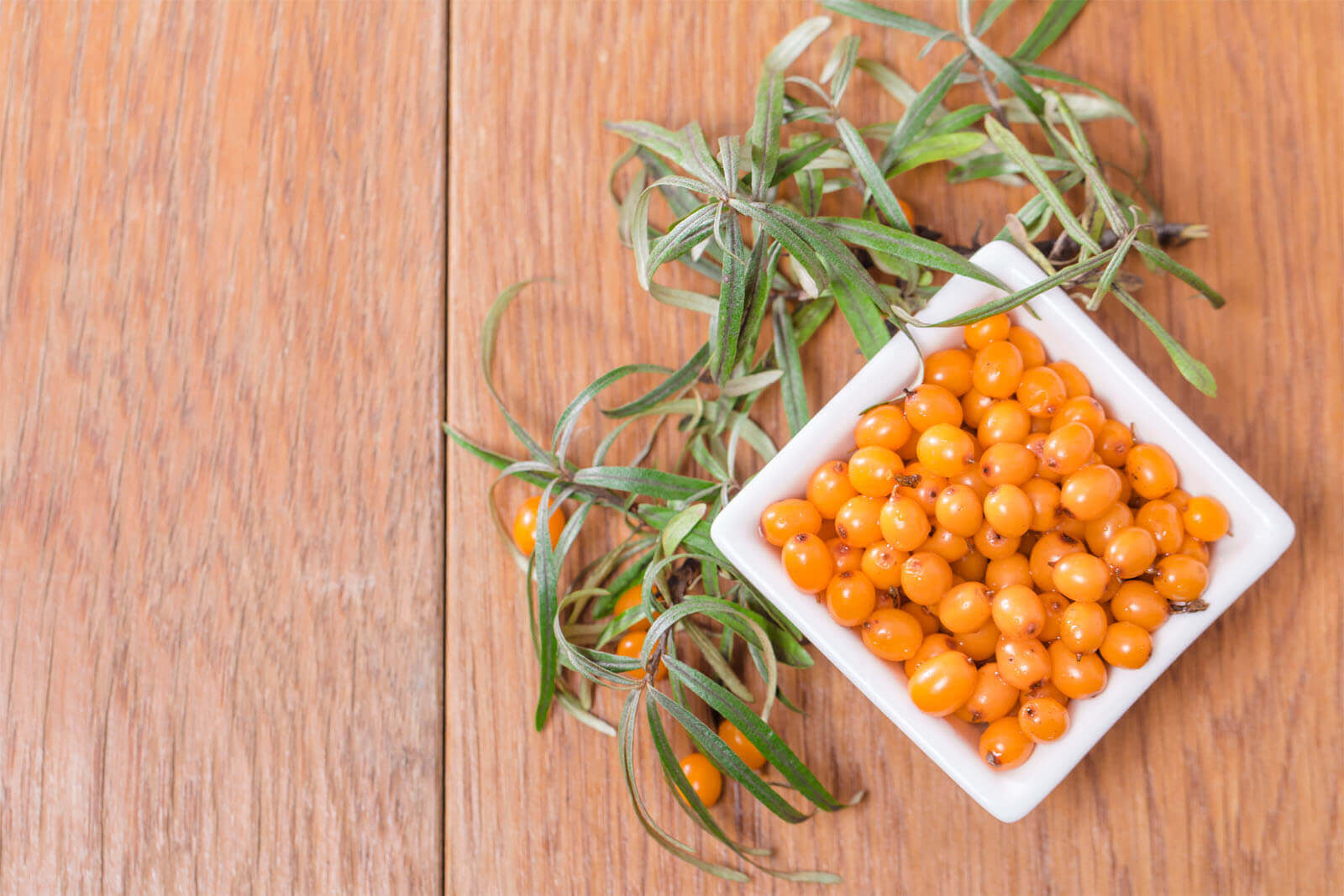
In AUSTRALIA, we refer to the plant Hippophae rhamnoides as SEA BUCKTHORN. Other countries refer to it as sandthorn, sallowthorn or seaberry…..they are all the same plant.
And this plant thrives over a wide area of Europe and Asia in the cold latitudes. It will be found from the Atlantic costs of Europe all the way across to NW Mongolia and NW China. The existence of the coastal growth arises due to its ability to withstand salt spray that prevents other larger plants out-competing it. The existence of the arid semi-desert growth in Asia is due to its ability to survive the dry conditions that do not support other plant growth. So whilst the plant is tolerant to salt in the air and soil, it does need full sunlight. These plants typically grow in dry, sandy areas.
What is the difference between Sea Buckthorn BERRY Oil and Sea Buckthorn SEED Oil?
They are different and BOTH are essential. Do not settle for anything less than a 1:1 ratio of BOTH Sea Buckthorn SEED oil and BERRY oil.
They are two quite different products coming from two different parts of the berry. The SEED OIL contains a totally different nutritional makeup compared to the BERRY OIL which comes from the soft outer fruit flesh. Each oil is so different from the other that each can be uniquely applied for different purposes, and naturally, a combination of the TWO OILS (50-50 ratio) provides the total and broad nutritional components.
From “Sea Buckthorn Oils: Towards Healthy Mucous Membranes”, Risto Erkkola and Baoru Yang, AGROFood Industry hi-tech May/June 2003, the below table differentiates the two oils – even if it is a little hard to follow, you can clearly see that each oil is quite different from the other. A blend of both in equal parts is therefore essential.
This is the reason Sea Buckthorn Complete Vitality soft gel capsules contain equal parts of BOTH OILS.
| Carotenoids(mg/100 g) | Plant sterols(weight %) | Tocopherols and tocotrienols(mg/100 g) | |
|---|---|---|---|
| Seed Oil | 10-50 | 1-2 | 100-200 |
| Pulp Oil | 100-400 | 2-3 | 100-400 |
What are carotenoids?
They are colourful pigments in fruit and vegetables, some of which the body can turn into Vit A. These pigments are powerful antioxidants.
Orange and yellow fruits and vegetables are high in this yellow pigment and the body can turn some of these colourful pigments into Vit A – we have all heard how “carrots can improve night vision”
The Sea Buckthorn berry has the beautiful yellow-orange pigment and our Sea Buckthorn Complete Vitality uses both the seed oil and the berry oil – more carotenoids are in the berry oil 100-400mg/100 g berry oil; seed oil contains about 10% compared to berry oil. Refer to table above.
What are Plant sterols?
Plant sterols (or phytosterols) are a naturally occurring part of all plants. They are mainly found in vegetable oils but are also present in smaller amounts in nuts, legumes, grains, cereals, wood pulp and leaves. The main sources of plant sterols added to foods in Australia are soybean oil or tall (pine) oil. The Australian Heart Foundation recommends for dults needing to lower LDL-cholesterol to consume 2 to 3 grams of plant sterols per day from plant sterol enriched foods. Consuming more than this amount will not do harm but will not give any additional benefits.
What are Tocopherols and tocotrienols?
Both belong to the Vit E family which hold anti-oxidant properties.
So: What Does Sea Buckthorn SEED OIL Offer?
The Sea Buckthorn Seed oil contains near-equal quantities of the essential fatty acids Omega 6 (linoleic acid) and Omega 3 (alpha linolenic acid).
Linoleic acid (Omega 6) has been shown in studies to maintain the cardiovascular system and may function to reduce inflammation, blood pressure and cholesterol.
Alpha linoleic acid (Omega 3) is known to help the body repair its cells and provides the skin moisturising qualities that has this oil so well regarded for skin care.
The seed oil contains Vit E and carotenoid which have anti-oxidant properties.
The seed oil is of orange appearance……whilst the berry oil (ie the fleshy fruit or pulp) is of a redder appearance. You will therefore recognise from the beautiful pinkish hue that our Sea Buckthorn Complete Vitality soft gel capsules are a combination of both these oils. When combined, they work to revitalise the largest organ of our body: the skin. In fact the botanical name Hippophae rhamnoides means “shiny horse” since the fruit put into horse’s feed in ancient Greek times brought about a beautiful glossy skin health.
And, What Does Sea Buckthorn BERRY OIL Offer?
The red berry oil colour comes from the high concentration of carotenoids (10 times more than the seed oil)… carotene is known to assist night vision health. The berry oil also imparts skin moisturising qualities that studies have shown to improve minor skin conditions such as dermatitis, eczema, minor burns including sunburn. It may be used for the relief and treatment of cuts, abrasions and bruising.
PLEASE: always read the label. If symptoms persist, see your healthcare professional.
And the next important question posed is…
how is the oil extracted?
This is extremely important because some extraction processes can harm the end result.
Firstly, know that extracting the oil produces a concentrated product which equates to consuming a large quantities of the berries and crushed seeds – difficult, tedious and expensive. the concentrated oil is more convenient, especially when delivered in a soft gel capsule.
Traditionally, the fruit pulp and seed is soaked in chemical solvents of a relatively harmless nature. The solvents are chosen for the least damage the do to the fruit and the least risk to the consumer. Whilst this has been quite effective, it is clear that it surely is not the most desirable method of extraction.
More recently, supercritical CO2 extraction with its host of benefits has been used. The resulting oil retains the EFAs (essential fatty acids, ie the range of Omegas 3,5,6,7 and 9), proteins, vitamins, carotenoids, sterols – in fact all the beneficial components that the berry and seed offer in combination. No solvents are used and there is ample reporting of the efficacy of supercritical CO2 extraction as compared to traditional methods (using solvents) and steam distillation (ie temperature).
Our Sea Buckthorn Complete Vitality soft gel capsules contain equal parts of the seed oil and the berry oil, both of which are produced by supercritical CO2 extraction
Benefits of supercritical CO2 extraction include:
- CO2 is non toxic and GRAS (generally regarded as safe)
- no toxins, heavy metals or hydrocarbon materials come into contact with the extracted oil
- it means that extraction solvents such as propane, butane, hexane, pentane, athanol/alcohol are not used
- CO2 extraction occurs at temperatures native to the botanical material thereby minimising thermal degradation of the plant material and extracted oil
- the solvency power of the supercritical CO2 extraction method can be adjusted to best suit the botanical material to be extracted
the efficacy of Sea Buckthorn Oil compared with Sea Buckthorn Juice or Berry?
This is an interesting question and it comes down to how the juice and oil are extracted? And how much juice or oil is ingested, or how many berries eaten?
The fruit yields approximately 65% juice centrifugally so 100 berries yields up to about one quarter a 250gr glass but it has no nutritients from the important seed (highest amounts of omegas 3, 6 and 9). Some juice extraction processes can damage the juice with heat so that information must not be overlooked.
The oil is very concentrated forming approximately 4% of the entire berry so just one 500mg Sea Buckthorn Complete Vitality soft gel capsule is the equivalent of about 50 whole berries (pulp and seed).
But the oil extraction process is important also as some processes use chemicals. The extraction process considered the best is “supercritical CO2 extraction” and that is the process by which the Sea Buckthorn Complete Vitality is acquired.
Sea Buckthorn Complete Vitality is pure sea buckthorn berry oil and seed oil, nothing added, for healing and tissue regeneration, omegas 3,5,6,7 and 9, Vits C and E.
Gallery